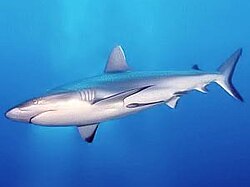
Sharks (superorder Selachimorpha) are a type of fish with a full cartilaginous skeleton and a highly streamlined body. They respire with the use of five to seven gill slits. Sharks have a covering of dermal denticles that protect their skin from damage and parasites and improve fluid dynamics. They have several sets of replaceable teeth.[1] Sharks range in size from the small dwarf lanternshark, Etmopterus perryi, a deep sea species of only 17 centimetres (7 in) in length, to the whale shark, Rhincodon typus, the largest fish, which grows to a length of approximately 12 metres (39 ft) and which feeds only on plankton, squid, and small fish through filter feeding.
The bull shark, Carcharhinus leucas, is the best known of several species that swim in both seawater and freshwater, as well as in deltas.[2]
The popular image of a goldfish in a fishbowl is an enduring one. However, some countries have banned the sale of bowls of that type under animal rights legislation due to the risk of stunting, deoxygenation and ammonia/nitrite poisoning in such a small environment.[11] Because of their large oxygen needs and high waste output, the popular goldfish bowls of the past are not appropriate housing for goldfish.[12]
Like most carp, goldfish produce a large amount of waste both in their feces and through their gills, releasing harmful chemicals into the water. This also happens because goldfish, like other cyprinids, lack a stomach and only have an intestinal tract, and thus cannot digest an excess of proteins, unlike most tropical fish.[citation needed] Build-up of this waste to toxic levels can occur in a relatively short period of time, which is often the cause of a goldfish's sudden death. Because of this, goldfish need a large volume of water in which to live. For common and comet varieties, each goldfish should have about 20 gallons(US) or 75 liters of water. Fancy goldfish (which are smaller) should have about 10 gallons(US) or 37.5 liters per goldfish. The amount of 'water surface area' is also important in determining how many goldfish may live in a container, as water surface area determines how much oxygen diffuses and dissolves from the air into the water. A general rule is have one square foot of water surface area for every inch of goldfish length (370 cm²/cm). If the water is being actively aerated by way of a water pump, filter or fountain, a smaller volume of water is needed.

Goldfish are popular pond fish, since they are small, inexpensive, colourful, and very hardy. In an outdoor pond or water garden, they may even survive if brief periods of ice form on the surface, as long as there is enough oxygen remaining in the water and the pond does not freeze solid.
Common goldfish, London and Bristol shubunkins, jikin, wakin, comet and sometimes fantail goldfish can be kept in a pond all year round in temperate and subtropical climates. Moor, veiltail, oranda and lionhead can be kept safely in outdoor ponds only in the summer, and in more tropical climates.
Small to large ponds are fine though the depth should be at least 80 cm (30 in) to avoid freezing. During winter, goldfish will become sluggish, stop eating, and often stay on the bottom of the pond. This is completely normal; they will become active again in the spring. A filter is important to clear waste and keep the pond clean. Plants are essential as they act as part of the filtration system, as well as a food source for the fish. Plants are further beneficial since they raise oxygen levels in the water.

The Common, Comet, and Shubunkin varieties of goldfish are similar to wild carp (except for colour). They are hardy and can grow to a large size. Other more fancy varieties have been developed.
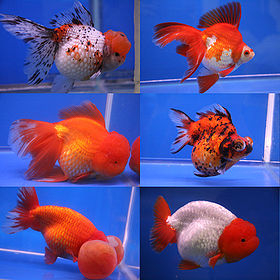
The main fancy varieties are: Black Moor, Bubble eye, Butterfly tail, Calico, Celestial eye, Fantail, Lionchu, Lionhead, Oranda, Panda Moor, Pearlscale, Pompom, Ranchu, Ryukin, Telescope eye, and Veiltail.[10] Rare fancy varieties include: Tosakin or curly fantail, Jikin or peacock tail, Shukin, Tamasaba or sabao, Meteor goldfish, Egg-fish goldfish, Curled-gill goldfish or reversed-gill goldfish, Mirror-scale goldfish.
The goldfish has a fairly self explanatory name: "gold" describing its color, and "fish" describing its species. Goldfish are a relatively small member of the Cyprinidae or carp family. The Cyprinidae family is the largest family of freshwater fishes in the world. Apart from the goldfish, other well-known members include the minnow, chub, shiner, zebrafish, various Asian carps and koi.
Selective breeding over centuries has produced many different color variations, some of them far removed from the 'golden' color of the original goldfish. There are also different body shapes, fin and eye configurations. Some extreme versions of the goldfish need to be kept in indoor aquariums as they are much less hardy than varieties closer to the "natural" original. However, some varieties such as the Shubunkin are hardier, and can be kept in outdoor pools.
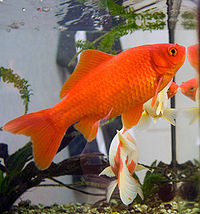
In 1162, the Empress of the Song Dynasty ordered the construction of a pond to collect the red and gold variety of those carp. By this time, people outside the imperial family were forbidden to keep goldfish of the gold (yellow) variety, yellow being the imperial color. This is probably the reason why there are more orange goldfish than yellow goldfish, even though the latter are genetically easier to breed.[3]
The occurrence of other colors (apart from red and gold) was first recorded in 1276. The first occurrence of fancy tailed goldfish was recorded in the Ming dynasty. In 1502, goldfish were introduced to Japan, where the Ryukin and Tosakin varieties were developed. In 1611, goldfish were introduced to Portugal and from there to other parts of Europe.[2]
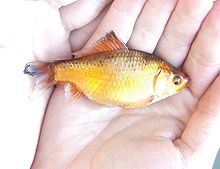
In ancient China, various species of carp (collectively known as Asian carps) had been domesticated and reared as food fish for thousands of years. Some of these normally gray or silver species have a tendency to produce red, orange or yellow color mutations; this was first recorded in the Jin Dynasty (265–420).
During the Tang Dynasty (618–907), it was popular to raise carp in ornamental ponds and watergardens. Due to a natural genetic mutation, some of these carp displayed gold (actually yellowish orange) rather than silver coloration. People began to breed the gold variety instead of the silver variety, and began to display them in small containers. The fish were not kept in the containers permanently, but would be kept in a larger body of water, such as an outdoor pond, and only for special occasions at which guests were expected would they be moved to the much smaller container.[2]


